Learn
The grains, honestly.
What millets really offer — the well-supported benefits, the honest limits, and why they matter for the planet.
The five siridhanya, by the numbers
Per 100g (raw)
| Per 100g (raw) | Protein | Fibre | Iron | Glycemic index |
|---|---|---|---|---|
| Foxtail · ನವಣೆSetaria italica | Protein12.3 g | Fibre8.0 g | Iron2.8 mg | Glycemic index54 (low) |
| Browntop · ಕೊರಲೆBrachiaria ramosa | Protein~10.7 g* | Fibre~8 g* | Iron~8.9 mg* | Glycemic indexnot established |
| Kodo · ಹಾರಕPaspalum scrobiculatum | Protein8.3–8.9 g | Fibre6.4 g | Iron0.5–2.3 mg | Glycemic index65 (intermediate) |
| Little · ಸಾಮೆPanicum sumatrense | Protein7.7–10.1 g | Fibre7.7 g | Iron1.2–9.3 mg† | Glycemic index64 (intermediate) |
| Barnyard · ಊದಲುEchinochloa frumentacea | Protein6.2–11.2 g† | Fibre9.8 g | Iron5–15 mg† | Glycemic index42 (low) |
* Browntop is data-poor (absent from standard food-composition tables) — figures are indicative only. † Sources disagree widely; ranges shown. Primary source: IFCT 2017 (NIN); GI from Anitha et al. 2021.
What millets can & can't do
Well-supported: high dietary fibre; lower average glycemic index than white rice and refined wheat; good iron and magnesium; naturally gluten-free; may help manage blood sugar and cholesterol as part of a balanced diet.
We don't claim: that millets cure or reverse diabetes, cancer, thyroid, PCOD or any disease. There is no clinical evidence for that, and some millets can even affect thyroid function. Not all "positive" millets are low-GI — kodo and little are intermediate.
Prepare them well: soaking and fermenting reduce anti-nutrients (phytic acid) and improve mineral absorption. Buy clean, well-stored grain — kodo in particular should never be mouldy.
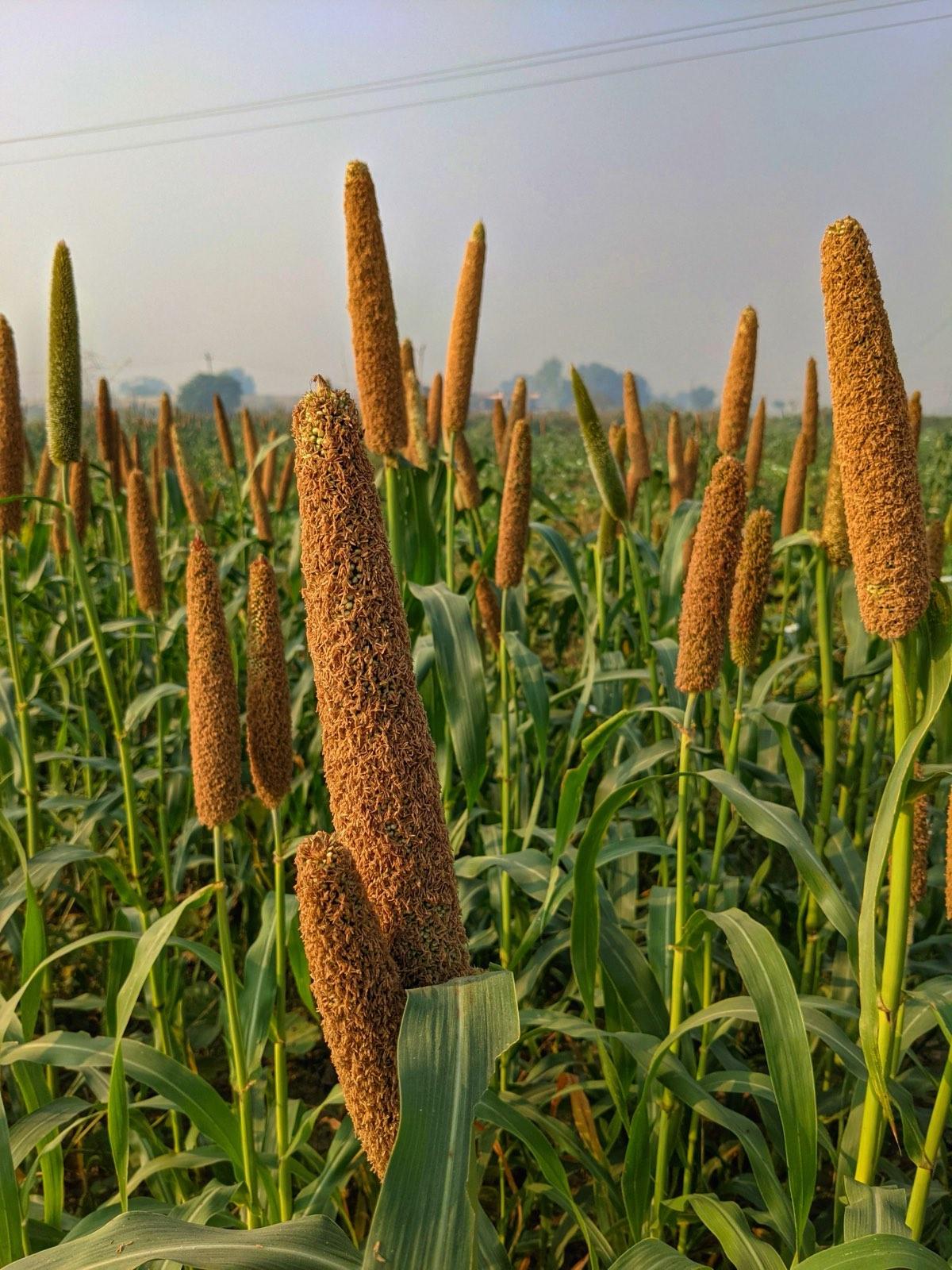
Millets are a nutritious whole grain that can support a balanced diet; they are not a treatment or cure for any disease. Consult a qualified doctor before changing your diet to manage a medical condition, and never stop prescribed treatment.
For the planet
A C4 crop for a thirsty world.
Millets use C4 photosynthesis — more grain per drop. They grow rainfed where rice cannot, need little or no fertiliser, and ripen in 45–90 days. In India, rice's irrigation water footprint is roughly five to seven times that of millets.
Sources: FAO (International Year of Millets 2023), ICRISAT, Davis et al. 2018.
Sources
Indian Food Composition Tables 2017 (NIN) · USDA FoodData Central · Anitha et al., Frontiers in Nutrition 2021 (glycemic response) · FAO International Year of Millets 2023 · ICRISAT · Davis et al., Science Advances 2018.